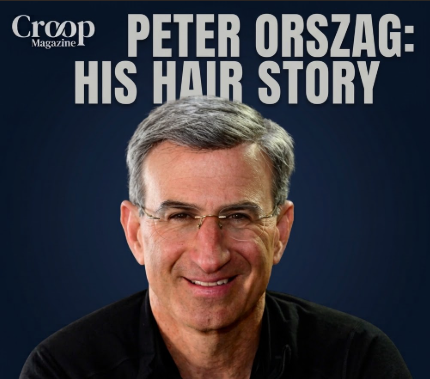
Peter Orszag is not a celebrity in the traditional sense, yet his face is familiar to anyone who follows U.S. economic policy or global finance. As former Director of the Office of Management and Budget under President Barack Obama and now CEO and Chairman of Lazard, he has lived a long stretch of his career in front of cameras, microphones, and financial news panels.
That visibility is exactly why something as ordinary as hair became an internet talking point. The search phrase Peter Orszag bald doesn’t come from any official biography or verified controversy. It comes from public curiosity, repeated exposure, and the way internet culture turns small visual details into lasting narratives.
So what is actually true, what is speculation, and why did this topic spread in the first place?
Who Peter Orszag Is and Why People Notice His Appearance
Peter Orszag built his career in economics, policy, and high-level financial advisory work. He served in senior roles in the U.S. government, later transitioned into investment banking, and eventually became one of the most visible executives in global finance.
Unlike many corporate leaders, Orszag frequently appears on television interviews and financial news programs. That matters, because repeated exposure creates familiarity. Once a public figure becomes visually familiar, even small changes in appearance begin to stand out to viewers.
Hair is one of the most noticeable features on camera. It frames the face, changes with age, and reacts strongly to lighting and camera resolution. For someone like Orszag, who has remained in the public eye for decades, those subtle changes become amplified simply because people have seen multiple versions of him over time.
Is Peter Orszag Bald? What the Evidence Actually Suggests
The most direct answer is simple: Peter Orszag is not bald.
Across public appearances over many years, he consistently shows a full head of hair. However, like many men in middle age, his hair has gradually changed in density and structure. This includes mild thinning and a slightly receded hairline compared to earlier years.
That distinction is important. Baldness typically refers to significant or complete hair loss, often involving large visible areas of scalp exposure. Orszag’s appearance does not match that description in any consistent or verified way.
Instead, what is observable aligns with normal age-related hair changes. Hair becomes finer over time, density reduces, and styling can influence how thick or thin it appears on camera. In Orszag’s case, nothing publicly visible goes beyond what is commonly seen in many professional men in their 40s, 50s, and 60s.
Why the “Bald” Label Spread Online
The internet rarely waits for medical definitions. It relies on perception, repetition, and humor. Once a topic enters online discussion, it can evolve independently of facts.
The “Peter Orszag bald” idea appears to have grown from this environment. A combination of factors contributed:
- Frequent television appearances during his government career
- High-definition interviews where hair density is more visible
- Side-by-side comparisons of older and newer photos
- Social media commentary that exaggerates small visual differences
None of these sources are authoritative. But collectively, they create a narrative loop. One person questions an appearance, others repeat it, and over time the question itself becomes the search trend.
Here’s the key point: search volume does not equal truth. It only reflects curiosity.
The Hairpiece and Wig Speculation
A major part of the online discussion revolves around whether Peter Orszag wears a hairpiece or wig. This idea has circulated in blogs, comment sections, and informal commentary for years.
However, there is no confirmed evidence supporting this claim.
No public statement from Orszag exists addressing hair systems. No investigative journalism from credible financial or political reporting outlets has documented such a claim. And importantly, no consistent visual proof shows abrupt changes in hair density that would typically suggest a hair system.
What remains is speculation driven by perception rather than verification.
In reality, modern grooming, hair products, and professional styling can create a highly consistent appearance on camera. For public figures, especially those in finance and politics, maintaining a controlled visual presentation is standard practice.
How Camera Work and Lighting Influence Perception
One of the most overlooked reasons this topic exists is technical rather than personal.
Studio lighting is designed to eliminate shadows on the face, but it often has the side effect of making hair appear thinner or more reflective. High-resolution cameras also pick up scalp visibility that is not noticeable in person.
Angles matter too. Slight downward or overhead shots can change how hair density is perceived. Even minor adjustments in styling products can make hair appear flatter or more structured depending on the setting.
This is why public figures often look slightly different across interviews, even when nothing has actually changed.
Male Pattern Hair Changes: The Normal Baseline
Without diagnosing any individual, it is useful to understand the general pattern most men experience.
Male pattern hair changes are extremely common and typically follow a slow progression:
- Slight recession of the hairline over time
- Gradual thinning at the crown or front
- Reduced density rather than full baldness
- Variation depending on genetics and age
What matters here is variability. Two men of the same age can look completely different in terms of hair coverage. Some retain thick hair well into later life, while others experience noticeable thinning early on.
In Orszag’s case, the visible pattern fits comfortably within the normal range of age-related change.
Why Public Figures Get Scrutinized for Hair
There is a deeper social reason this topic keeps resurfacing. Public figures are often evaluated visually before they are evaluated intellectually.
For someone like Peter Orszag, whose work is highly technical and policy-driven, most people outside finance engage with him through brief media appearances. That creates a narrow lens: face, tone, appearance, and presentation.
Hair becomes an easy focal point because it is visible, non-technical, and universally recognizable. It requires no expertise to comment on, which makes it a common target for online discussion.
But here’s the catch: visibility does not equal relevance.
Misinterpretation vs Reality
When you separate perception from evidence, the picture becomes clearer.
On one side, you have:
- Online commentary
- Repeated search trends
- Visual comparisons without context
On the other side, you have:
- Consistent public appearances
- No verified claims of a hair system
- Normal age-related hair variation
These two categories do not carry the same weight.
The reality sits firmly in the second category.
Why the Topic Persists Despite Lack of Evidence
Even when a rumor lacks support, it can survive for years online. That usually happens when:
- The subject is frequently photographed
- The detail is visually noticeable but not extreme
- There is no official response to confirm or deny it
- The topic is easy to repeat and meme
Peter Orszag fits all four conditions. That is enough for a topic to remain searchable long after it stops being meaningful.
Conclusion
The question “Is Peter Orszag bald?” is less about biology and more about perception. Public evidence does not support the idea of baldness or a hair system. What is visible instead is a normal, gradual change in hair density consistent with aging.
The internet often takes subtle visual differences and turns them into lasting narratives. In this case, the narrative outgrew the evidence.
Peter Orszag’s career is defined by economics, policy, and financial leadership—not by his hairline. And when you strip away speculation, that is the part of his public identity that actually remains consistent and verifiable.