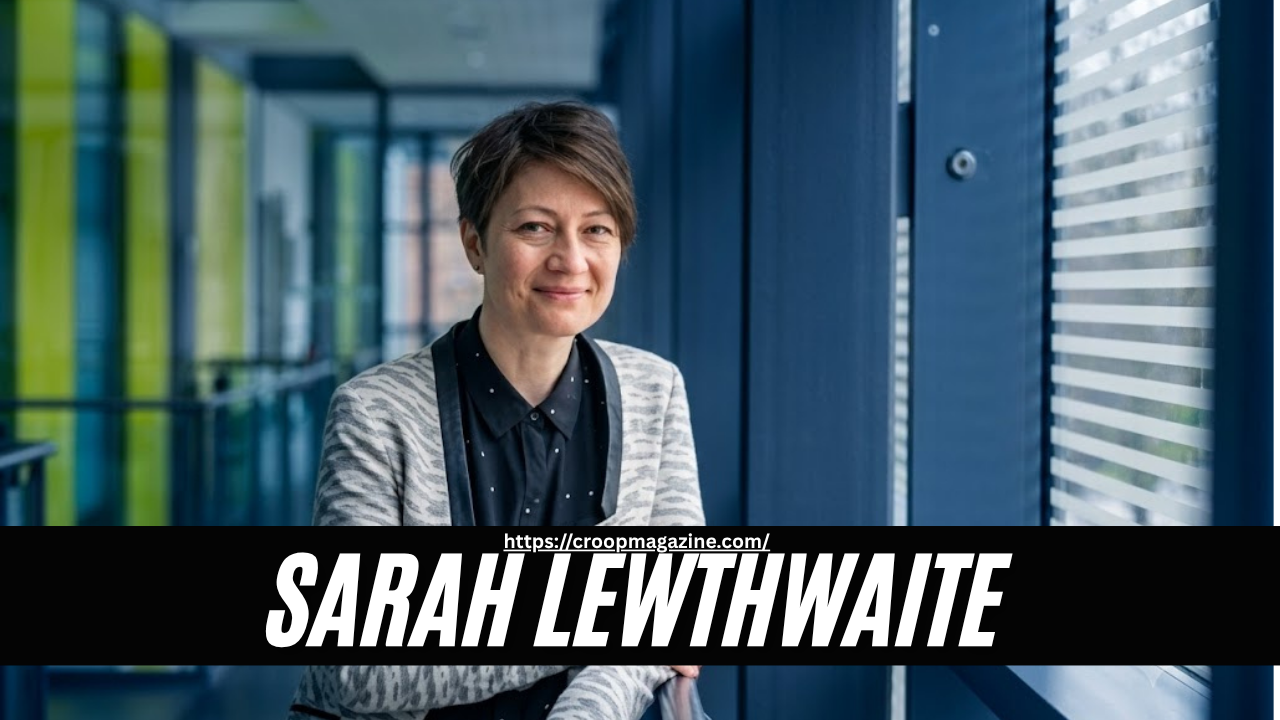
Sarah Lewthwaite’s work sits in a space that most people never notice until something stops working. A video that cannot be captioned, a form that cannot be read by a screen reader, a digital classroom that excludes rather than includes. Her research focuses on those gaps between technology and real human access, especially in education and professional training.
She is part of a growing group of academics who treat accessibility not as a technical checklist, but as a question of how knowledge itself is designed, shared, and understood. That perspective shapes her career across higher education, research leadership, and policy-relevant academic work.
Academic identity built around inclusion and access
Sarah Lewthwaite works within UK higher education as a senior academic researcher, based at the University of Southampton. Her role is not centered on public visibility or media presence. Instead, it is rooted in long-term research programmes that examine how people learn, and more importantly, who gets left out when systems are not designed carefully.
Her academic work is tied to inclusion, disability studies, and education systems. That combination places her in a field where theory and real-world application overlap constantly. She is not only studying accessibility as an idea, but also how it is taught, misunderstood, or ignored in practice. What makes her position distinct is the focus on education itself. Rather than only asking whether digital tools are accessible, her research asks a more uncomfortable question: are we actually teaching people how to build accessibility into what they create?
A career shaped by research, not public profile
Unlike figures in public-facing science or media, Lewthwaite’s career is not built around visibility. There are no celebrity-style interviews or public campaigns attached to her name. Instead, her influence comes through academic work, publications, and funded research projects.
Her background includes doctoral research in the UK academic system, followed by positions in research environments where she worked across education, disability studies, and digital participation. This progression reflects a common academic path, but her focus narrowed over time toward accessibility as a central theme That focus matters because accessibility is often treated as a specialist subject. Her work challenges that assumption by placing it inside mainstream education research rather than separating it from it.
Why digital accessibility became the core of her work
Digital systems are now embedded in almost every part of daily life, from university lectures to job applications and government services. But those systems are not always designed with all users in mind. That gap is where accessibility research becomes important.
Lewthwaite’s work focuses on how people are trained to recognize and fix those gaps. Instead of only studying accessibility as a technical standard, she looks at how it becomes part of professional thinking. In many industries, accessibility is still learned informally, often late, and sometimes not at all.
Her research suggests that this is not just a technical problem. It is an educational one. If accessibility is not embedded in training, it becomes optional in practice, and that leads to inconsistency across systems that should be reliable.
Research leadership and funded academic work
Within her academic career, Lewthwaite has been involved in research leadership roles and funded projects connected to UK research institutions. These projects typically focus on education, inclusion, and digital systems used in learning environments.
Rather than short-term studies, her work is structured around longer research programmes that examine how accessibility knowledge is developed over time. That includes how universities teach it, how professionals learn it in workplaces, and how policy frameworks influence both. This type of research sits at the intersection of education theory and applied digital design. It is not only about identifying problems, but about understanding why those problems keep repeating across different systems.
Teaching accessibility as a skill, not a theory
One of the most consistent themes in Lewthwaite’s work is the idea that accessibility should be taught as a practical skill rather than an abstract concept. In many academic environments, accessibility is still introduced as a compliance requirement. Students may learn guidelines or legal frameworks, but not always how to apply them in real design situations. Her research challenges that gap between theory and practice.
She explores how accessibility can be integrated into everyday teaching across disciplines like computer science, design, education, and social sciences. The goal is not to create separate courses for accessibility, but to make it part of how digital thinking is taught from the beginning.
Disability studies and critical perspective
Lewthwaite’s work is also shaped by disability studies, a field that examines how society constructs disability through systems, language, and design choices. This perspective changes the way accessibility is understood. Instead of treating disability as a limitation that needs accommodation, it reframes accessibility as a design responsibility. In other words, barriers are not inevitable—they are built into systems and can be removed.
That shift in thinking is central to her research direction. It moves the conversation away from reactive fixes and toward proactive design decisions.
Academic influence beyond traditional publication
Academic impact is often measured through publications, but in fields like accessibility research, influence also shows up in teaching methods, training frameworks, and institutional policy. Lewthwaite’s work contributes to that broader impact by influencing how educators and researchers think about inclusion. Her research is often used in discussions about curriculum design, especially in higher education environments that are trying to modernize digital skills training. This kind of influence is slower but more structural. It shapes how systems are built rather than how they are discussed publicly.
Public presence and professional privacy
Despite her academic role, Sarah Lewthwaite is not a public-facing figure. She does not operate as a media commentator, and she does not build a personal public brand around her research. That level of privacy is common in academic environments where the work is intended for institutional, educational, or policy audiences rather than general media consumption. As a result, most public knowledge about her comes from institutional profiles, academic publications, and research project summaries rather than interviews or public appearances.
Why her work matters now
Digital accessibility is no longer a niche concern. It affects education systems, workplaces, and government services at scale. As more services move online, the cost of poor accessibility increases, both socially and economically. Lewthwaite’s research is relevant because it focuses on prevention rather than correction. Instead of asking how to fix inaccessible systems after they are built, her work asks how to teach people to avoid building them in the first place. That shift matters because it changes where responsibility sits. It moves accessibility from a specialist task into everyday professional practice.
Conclusion
Sarah Lewthwaite’s work is not built around visibility, but around structure—how systems are designed, how people are taught, and how inclusion is understood in practice. Her research sits in a space where education and technology meet, and where small design decisions can have large consequences for access.
What makes her work significant is its direction of focus. Instead of treating accessibility as an afterthought, it places it at the center of learning and professional development. As digital systems continue to expand, that shift from reaction to design becomes increasingly important. Her research contributes to that transition in a quiet but consistent way.